Slide 1 of 3
"Our Waters are Not for Sale": Women Reclaiming Life in Coastal Bangladesh
The canals of Shyamnagar in Satkhira District used to flow with something more precious than money. Freshwater used to get carried through these dense networks of canals which sustained generations in this southernmost tip of Bangladesh. Families used to collect drinking water from these channels. Women also relied on the canals for cooking, washing, and watering their homestead gardens. Farmers utilised them to irrigate agricultural fields, and fishermen relied on these canals directly for their livelihoods. The water moved through the whole landscape and people's lives with a natural law that it belongs to everyone.
In October 2025, I had the opportunity to spend a week with the residents of Munshiganj Union of Shyamnagar Upazila as part of the programmatic activities under Governance for Climate Resilience (G4CR), a project implemented by Center for Natural Resource Studies (CNRS) with International Centre for Climate Change and Development (ICCCAD). That visit first brought me close to these people whose stories helped me realize how that long-standing agreement with nature was systematically broken in the 1980s.
Under the Structural Adjustment Programs launched by the World Bank and International Monetary Fund, Bangladesh restructured its water governance around market principles. Public water bodies such as jalmohals and khas khals were converted into leasable land. The ijara system transformed water into private property, auctioned to the highest bidder, and the winners were never the fishing communities that had depended on these waters for centuries but rather the businessmen, politically connected elites, and contractors with wealth and muscle. As a result, a human-made crisis ensued. Reports like the ‘Elite Domination of Freshwater Canals in Southwest Bangladesh 2024’ by the CGIAR Initiative on Asian Mega-Deltas revealed to the public the extent to which canal leaseholders were driven by profit to forcefully restrict community access to these wetlands.
For me, however, these were no longer just findings in reports. Through interviews and focus group discussions, it became clear to me that the tragedies of this community’s women following this transition were all woven from the same cloth.
“They treated the canals like their own private property. They put up fences so that we could no longer enter the wetlands, verbally abused those who tried to collect water,” said Sabina, a victim of natural resource mismanagement and abuse by elites. “Anyone who protested was met with threats.”
As a result, communities found themselves totally alienated from their own rights and access to fresh water. Canals were deliberately silted up or filled in to make them construction ready. Waterbodies were reclassified from "open" to "closed" to justify control by influential people. Profit incentives superseded socioecological harmony.
The consequences unfolded slowly. Community members repeatedly told me that, without enough access to freshwater, agricultural production collapsed and rice paddies turned into salt-encrusted wasteland. Fish populations also declined, and the lack of drainage made waterlogging a recurring issue. Food insecurity deepened into severe malnutrition, particularly among children, while cases of skin disease, hypertension, and waterborne illness rose alarmingly, all associated with salinity and contaminated water.
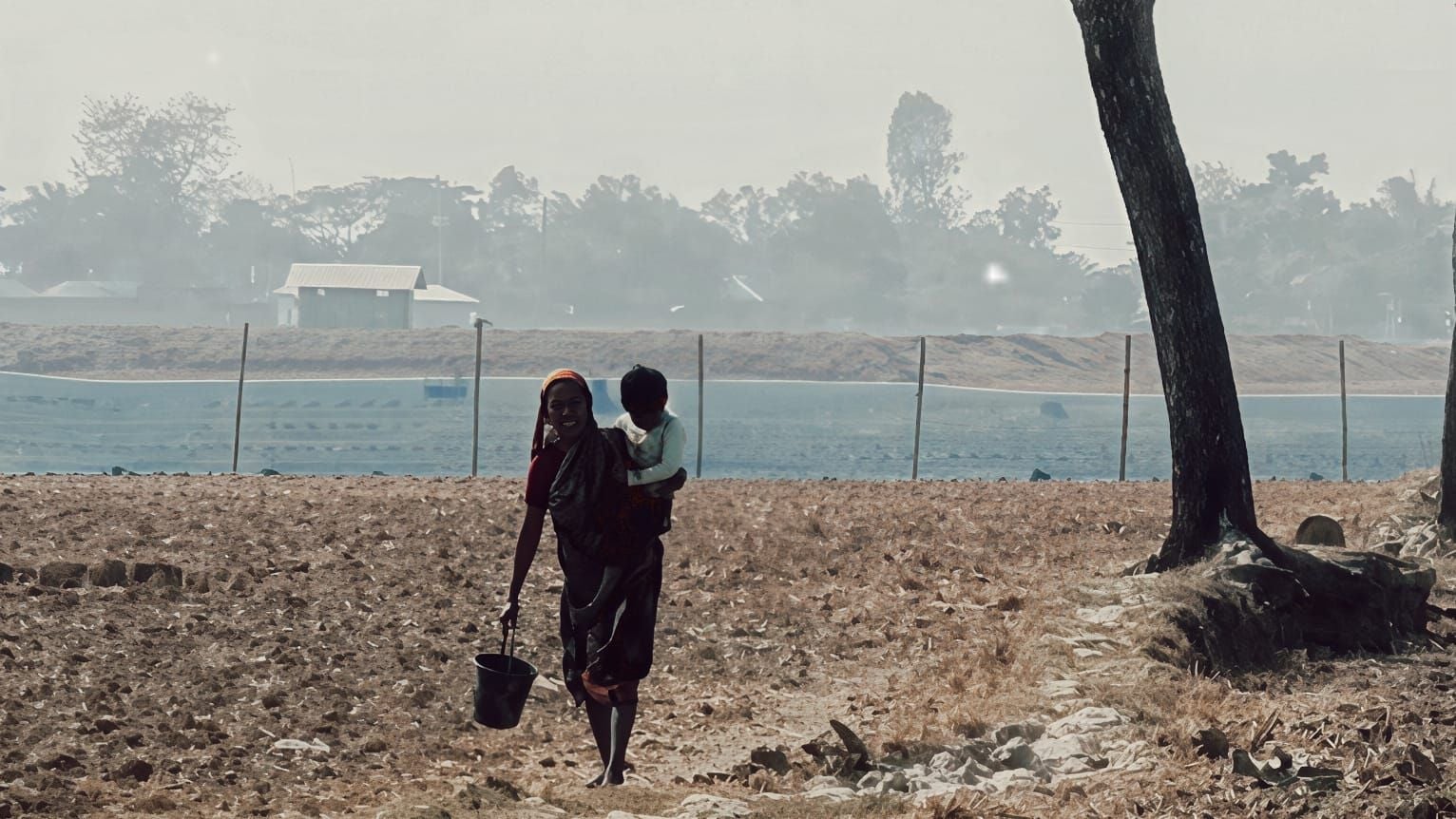
In Bangladeshi rural communities like Munshiganj, gender norms usually task women with the responsibility of household water. They collect it, store it, and use it. Therefore, freshwater scarcity directly multiplies women’s burden of work. They have no choice but to walk farther, wait longer, and bargain more for access to water. This disproportionate burden of the climate crisis on women goes beyond just extra hours of labour, and can often result in missed meals, untreated health conditions, etc. And to make matters worse, the working male population was forced to migrate to cities or abroad for work. Instead of acting as a support system for their families, they disappeared into urban labour markets.
A Story of Persistence and Change
During my visits, I also came to learn about this community’s incredible story of fighting for these canals since the early 2000s. At first, women from some villages of Munshiganj Union began to unite and started sharing what they know and their lived experiences. It didn’t take them long to discover that their individual struggles had common roots, so they had a common goal to pursue. That realisation motivated them to connect with local institutions, including NGOs, community leaders, and government officials to build legal literacy, through training and practical knowledge about land records, leasing documents, and administrative procedures. CNRS recognised the potential of these women early on and committed to providing this support where necessary as well. The pieces all started to fall in place for these women to eventually learn which offices mattered, which forms to file, and which officials had the authority to intervene.
Soon, this network of women began mobilising and fighting in the frontlines. Local women leaders and activists spearheaded movements and submitted petitions to the Upazila Nirbahi Officer (UNO)4 and the Land Office. They filed formal complaints against illegal leases held by businessmen with no connection to fishing or farming, which were in direct violation of policy. They arranged meetings in their homes, bringing together young girls, students, older women, and men from their community who had never spoken collectively about their water rights before.
But the local power structure did not welcome challenges from women who were expected to remain silent. Their pushback socially ostracised many women, while others faced direct threats.
“When I started joining meetings and protests and speaking about our right to water, they began warning me to stay quiet. One day they told me directly that if I continued doing this, I could be taken away,” said Khaleda, one of the women leaders and activists of the community movement.
This, however, only added fuel to the movement, which continued through regular protests and human chains. Gradually, they began to break down the obstacles standing in the way of their right to freshwater. They kept raising their voices and built stronger resistance against the leaseholders. When government officials visited, women were the first to meet them as citizens demanding enforcement of the existing law.
“We knew that words alone would not be enough, so we documented everything. We kept records of the policies that were being violated, gathered evidence from the ground, signed petitions, and carried our complaints from office to office until they were finally heard,” continued Khaleda.
The shift
As the movement gained momentum, illegal leases were terminated with support from government and non-government organizations. The women’s efforts led to the reclamation and rehabilitation of the wetlands in Munshiganj. Over time, canals reopened, and informal community water management committees were formed, with women leading the process. Water started to flow again. Not everywhere and not for all, but it was finally proof of the struggle not being in vain. This was claiming climate justice through action in its most grounded form. Not through carbon markets, green bonds, or the technocratic jargon of international negotiations, but through transforming existing power structures at the very root.
The women of Munshiganj illustrate why climate policies must go beyond environmental issues and consider social and institutional aspects like poor governance and community power dynamics that predate the current crisis as well. But more than anything, these women on the frontlines of climate action have made it very loud and clear that our waters are NOT FOR SALE.
Notes
Jalmohal: A public water body, such as a river stretch, canal, or wetland, officially designated by the state for leasing, fishing, or water-based resource use.
Khas khals: State-owned canals or water channels held as public property, traditionally meant for common use by local communities.
Ijara: A lease or rental arrangement through which the state grants temporary rights to use land or water bodies, often in exchange for payment.
Upazila Nirbahi Officer (UNO): Bureaucratic officer responsible for sub-district level administration
Shakib Alam Prithul is a climate change and development professional at Shushilan, a national NGO working across Bangladesh. He graduated in Anthropology from Jahangirnagar University. His work focuses on climate induced loss and damage, particularly non-economic loss and damage, adaptation limits, resource mobilisation and the lived realities of vulnerable communities in Bangladesh. He can be reached at sakibalam5@gmail.com
This article uses aliases to maintain the anonymity of the community members of Shyamnagar.