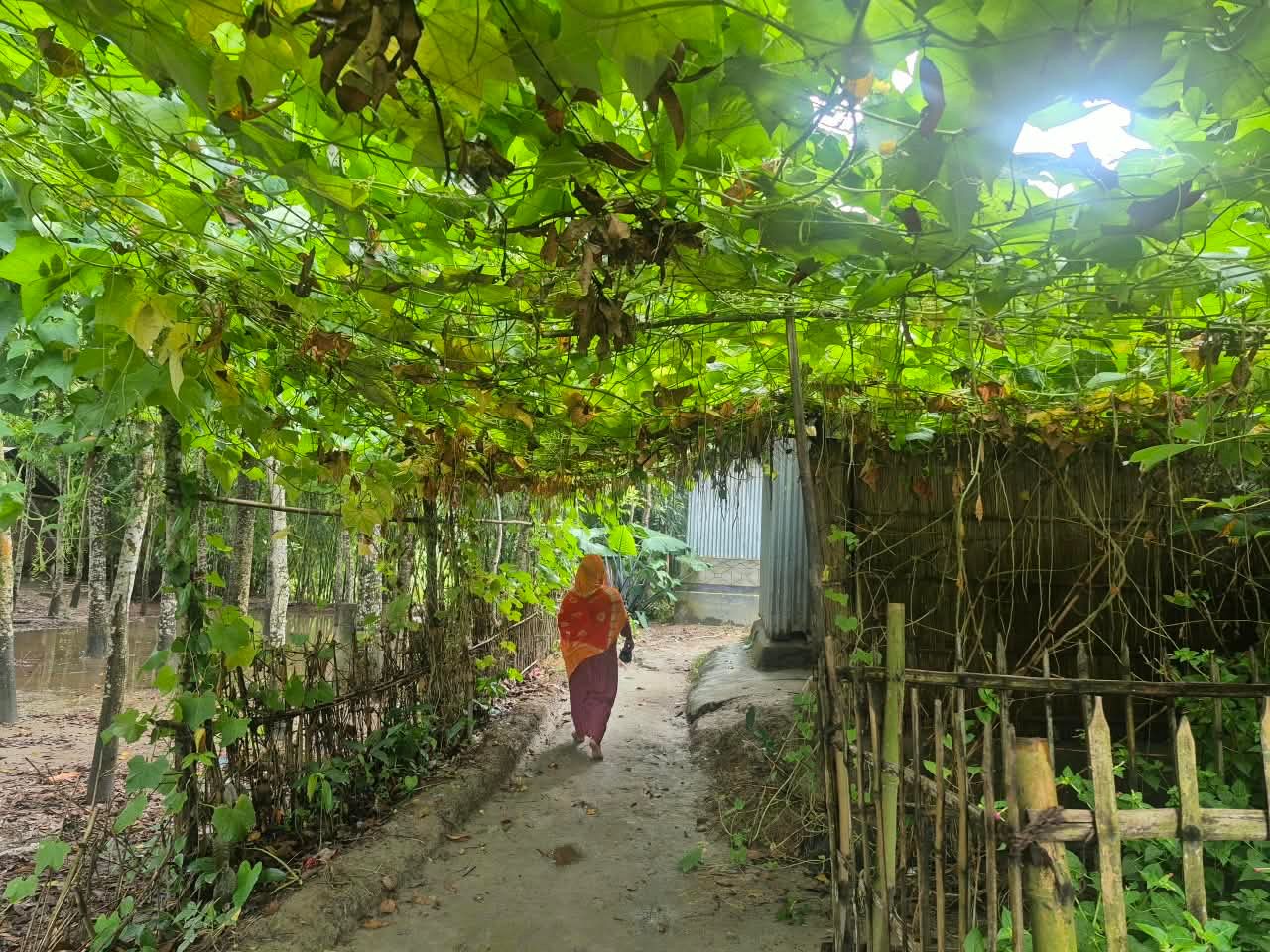
Before the Water Rises: How a Riverine Community Is Learning to Adapt

At four in the afternoon, Rahima Begum checks the river before she checks her crops.
She looks at the colour of the water, the speed of the current, and the small changes along the riverbank. She has lived beside the Brahmaputra long enough to know that a river does not always announce what it is about to do.
Sometimes the warning is a few inches of water. Sometimes it is a crack in the soil. Sometimes there is no warning at all.
For these communities, climate change is not a distant issue. It is a question of whether a harvest will survive, whether livestock can be moved in time, and whether the land called home will still exist next year.
Kurigram is among Bangladesh's most climate-vulnerable districts. Floods and river erosion repeatedly damage agricultural land, homes and livelihoods, while many households depend on marginal farming and daily labour.
Yet there is another side to this story: people are adapting.
The knowledge that already exists
When development workers first ask Rahima's community about adaptation, they might expect a list of needs such as stronger houses, better roads, financial assistance, etc. But ask the same community what they already know, and the answers look different.
They know which parts of the char flood first; they know which crops withstand excess water; they know which belongings to move first when the rivers rise which elderly neighbours need help evacuating; and which paths become impassable during heavy flooding.
This knowledge is rarely written into technical reports. It is inherited, observed and shared. Research on Bangladesh's riverine islands has similarly found that char communities develop their own adaptation strategies in response to flooding, erosion, and livelihood risk.
This is why locally led adaptation matters. The goal should not be to bring a solution to a community; rather it should be to build one with the community.
When adaptation begins before disaster
In the past, many families could do little more than wait for floodwater to arrive and then depend on relief. That is now gradually shifting toward preparing before disaster strikes.
Bangladesh has already shown the potential of anticipatory action. According to the United Nations Bangladesh Humanitarian Response Plan, in 2024, forecast-based triggers were used ahead of riverine flooding in the Jamuna basin, allowing cash, agricultural inputs, WASH supplies and protection services to reach roughly 600,000 people across five northern districts before peak flooding.
For a farming family, support that arrives before a flood makes a profound difference. A small amount of money can mean moving livestock in time. Agricultural inputs can mean restarting production afterward. Early warning information can mean moving documents and belongings before roads disappear.
The principle is simple: don't wait for people to lose everything before helping them prepare.
A different kind of resilience
There is another adaptation story unfolding in Kurigram. In recent years, initiatives have explored financial tools such as crop insurance to help farmers recover from climate shocks. A 2026 UN Bangladesh report highlighted a crop-insurance initiative in Kurigram designed to give farmers a financial shield after climate-related losses.
Adaptation is not only physical infrastructure but it is also financial resilience. A farmer may know exactly how to respond to a flood, but knowledge cannot replace lost income. A woman may know how to preserve seeds, but she may still need resources to restart cultivation. A family may know where to relocate temporarily, but rebuilding a home requires money.
Climate resilience has to include the ability to recover, not simply survive.
Let communities decide what resilience looks like
Bangladesh's efforts to localize adaptation plans are moving in this direction. The Local Adaptation Plan of Action guidelines developed through the LoGIC initiative aim to bring climate adaptation into local development planning, tailored to area-specific needs.
There is no single solution for resilience. For a coastal community, it may mean reducing salinity; for a drought-prone farmer, changing crops; for a char community in Kurigram, it may mean protecting livelihoods from floods and preparing for erosion-induced displacement.
The people experiencing the risks are best positioned to explain what resilience means in their own context. Locally led adaptation should not be reduced to community participation in a project designed elsewhere. It should mean giving communities a real role in identifying risks, setting priorities, choosing solutions, and evaluating whether those solutions work.
The river will not wait for us
Rahima returns to the river at sunset. The water is still moving. It always has.
The community cannot command the Brahmaputra to change course, cannot prevent every flood or stop every erosion event, but they can prepare. They can share information, diversify livelihoods, protect what can be protected, and demand resources before a disaster strikes. And they can ensure that the knowledge of the people who have lived alongside the river is treated as an asset, not an afterthought.
This is perhaps the most important lesson from communities like those in Kurigram: climate adaptation is not simply about making places stronger against hazards. It is about making people more capable of determining their own future in spite of those hazards.
The river will continue to rise. The land will continue to change. But resilience does not have to mean accepting loss as inevitable.
Sometimes, resilience begins with something much simpler: a community looking at the approaching water and saying, "We are ready."
Syeda Shimila Nahin is an undergraduate student at the Institute of Disaster Management and Vulnerability Studies in the University of Dhaka.