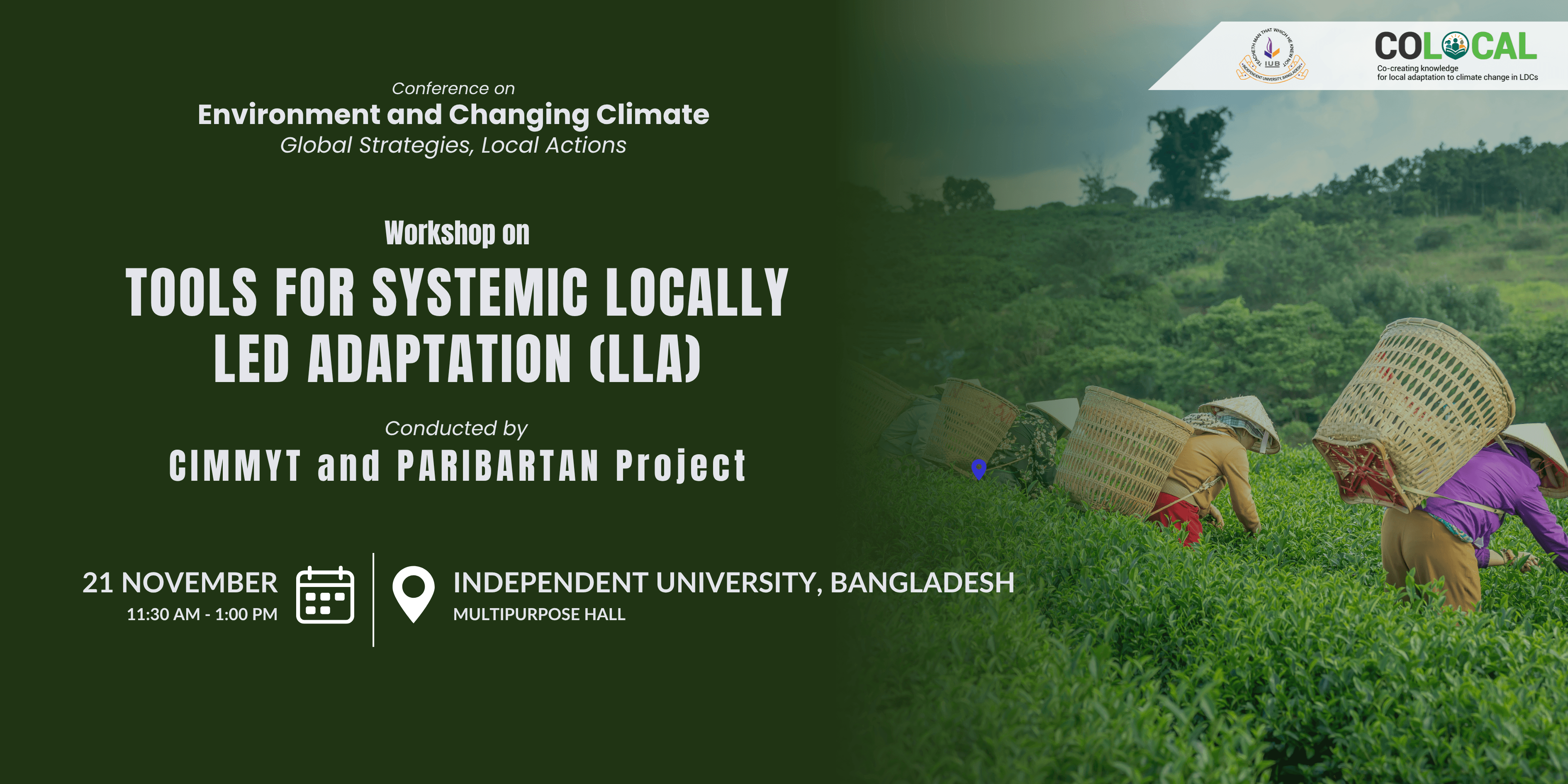
PARIBARTAN Project, CIMMYT and Shushilan Presented Tools for Locally Led Adaptation at ECC’25
The session titled “Tools for Systemic Locally Led Adaptation: Bridging Farmers, Markets, and Policy” was held on 21 November 2025 at Independent University, Bangladesh (IUB) as part of the Environment & Changing Climate 2025 conference . Organized under the PARIBARTAN project by ICCCAD, CIMMYT, and Shushilan, the session brought together more than 50 participants from academia, research institutions, NGOs, the private sector, and youth groups to explore how locally led adaptation (LLA) can be strengthened through systemic and participatory approaches.
Dr. Christine King, Consultant at CIMMYT, opened the session by outlining the integrated systems approach of the PARIBARTAN project. She emphasized that the initiative is not simply a research intervention but a co-learning platform where farmers, institutions, and private actors collectively shape adaptation pathways. Farhin Rahman Reeda from ICCCAD then facilitated an interactive Mentimeter exercise, encouraging participants to reflect on how farmers are perceived and what climate risks they face. Responses highlighted farmers as resilient yet vulnerable, with salinity intrusion, waterlogging, erratic rainfall, and weak water governance emerging as key concerns. The exercise also revealed that while participants understood the spirit of LLA, many lacked familiarity with its formal eight principles.
Bushra Anjum, Research Assistant at ICCCAD, presented the Adaptation Marketplace model, describing it as a “live laboratory” that connects farmers directly with seed companies, agri-tech firms, financial service providers, and digital advisory platforms. Farmers’ feedback underscored the need for stress-tolerant seeds, improved irrigation tools, reliable climate information, and stronger market linkages.
Mahanambrota Das from Shushilan shared a case study of a female farmer from Polder 31, illustrating how climate stress, limited irrigation access, market instability, and institutional gaps intersect with gendered vulnerabilities. Dr. Sharmin Afroz of CIMMYT introduced Political Economy Analysis (PEA), highlighting how adaptation is shaped by power relations, institutional histories, and governance structures. Dr. T. S. Amjath Babu further emphasized system assessment and innovation “packaging,” ensuring that agronomic solutions are supported by finance, markets, digital tools, and water governance coordination. Fahmida Khanam concluded with insights on strengthening Water and Agriculture Management Groups (WAMGs) as boundary organizations.
The session demonstrated that transformative adaptation requires farmer-centered learning, institutional strengthening, market engagement, and inclusive governance to build resilient agricultural systems in Bangladesh’s polder regions.