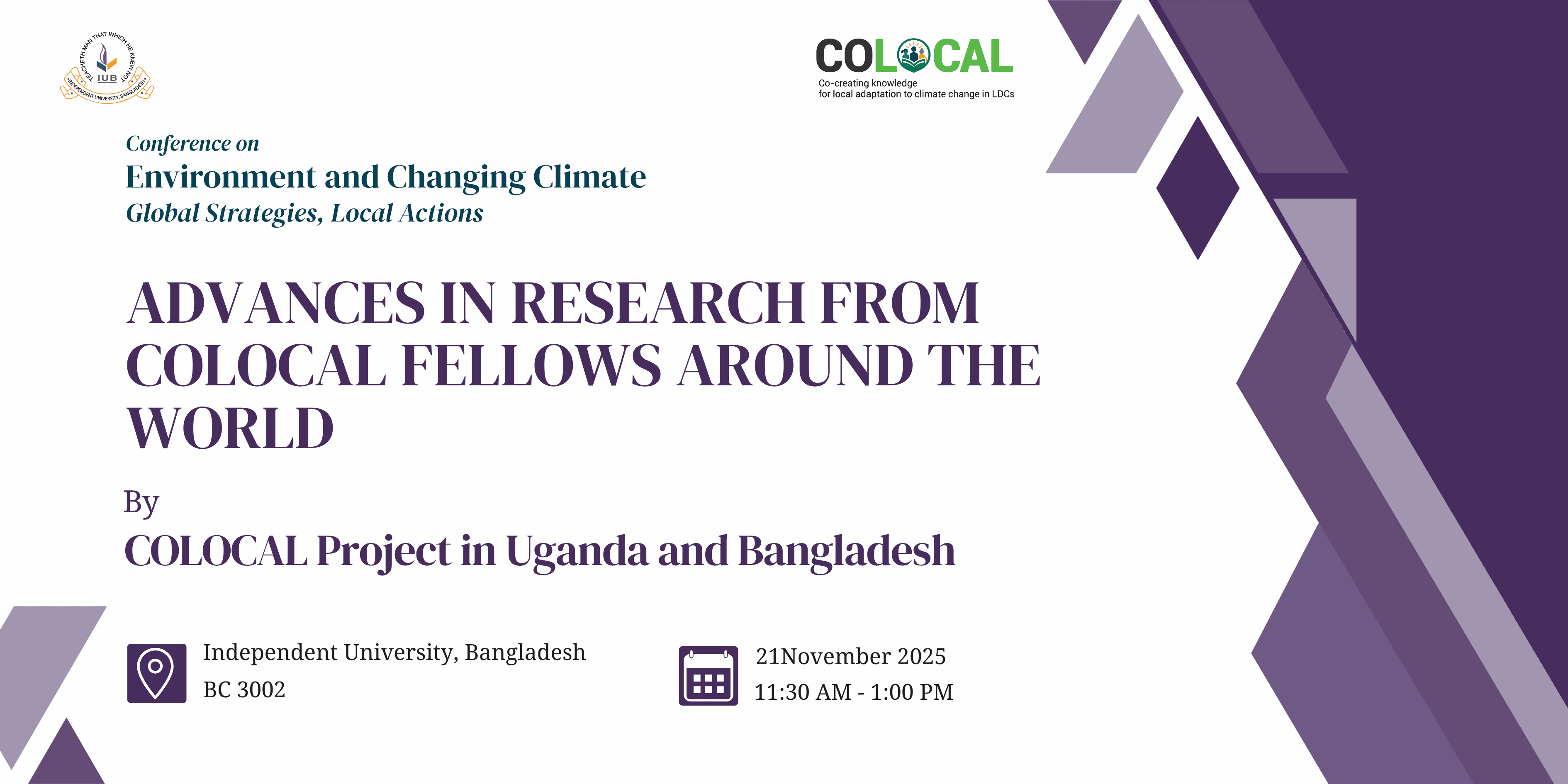
Advances in Research from COLOCAL Fellows Around the World Presented at ECC’25
On 21 November 2025, a session titled “Advances in Research from COLOCAL Fellows Around the World” was held at Independent University, Bangladesh (IUB) as part of the Environment & Changing Climate 2025 conference. Organized by Makerere University and Independent University Bangladesh, the session created a vibrant platform for fellows to present their research on locally led adaptation (LLA), community resilience, renewable energy, and climate governance across diverse global contexts.
Md. Julfikar Haider presented his research on operationalizing Locally Led Adaptation in climate-vulnerable regions of Bangladesh, particularly Shyamnagar in Satkhira. He examined how NGOs integrate LLA principles, identifying challenges such as centralized climate finance, policy misalignment, and representation gaps. His findings emphasized decentralization, institutional reform, and inclusive participation as essential for strengthening adaptive capacity and local ownership.
Celia focused on farmer-led, bottom-up collaborative learning for climate adaptation. Drawing from research in Kiboga District, she highlighted how inclusive community platforms—often led by women—support knowledge exchange and practical solutions such as water conservation and agroforestry. Her work underscored that adaptation is most effective when grounded in lived experience and collective learning.
Another research examined the impacts of salinity intrusion on agricultural systems, combining biophysical crop experiments with socio-economic surveys. The study aimed to quantify stress impacts and assess farmers’ willingness to adopt adaptation solutions which contributes to develope low-cost land reclamation strategies tailored to coastal Bangladesh.
Susan presented findings from drought-affected communities where farmers demonstrated resilience through collective action. Larger landholders voluntarily shared land for community use, while gravity-fed water systems and local markets were established to stabilize livelihoods. Her research illustrated how local initiative and cooperation can significantly strengthen resilience.
Ragib introduced a geospatial and multi-criteria analysis identifying suitable locations for Solar Irrigation Pumps (SIPs) in Bangladesh. His study revealed strong potential for renewable energy integration to reduce electricity pressure and support national climate commitments. The findings offer practical guidance for scaling sustainable irrigation solutions.
Victor explored the social and psychological impacts of climate stress on farming communities through in-depth interviews. He found that drought increases financial hardship and emotional strain, yet farmers remain determined and hopeful. His work highlighted the importance of training and support systems to strengthen psychological resilience.
Aasima concluded the session by presenting design thinking as a human-centered approach to climate governance. She proposed embedding iterative prototyping, community design labs, and feedback-driven monitoring into national climate frameworks. Her recommendations emphasized inclusive innovation as a pathway toward adaptive and responsive policymaking.
Together, the presentations reflected the interdisciplinary and global nature of COLOCAL fellows’ research, demonstrating how locally grounded knowledge and innovative methods can advance equitable and resilient climate adaptation pathways.