Slide 1 of 6
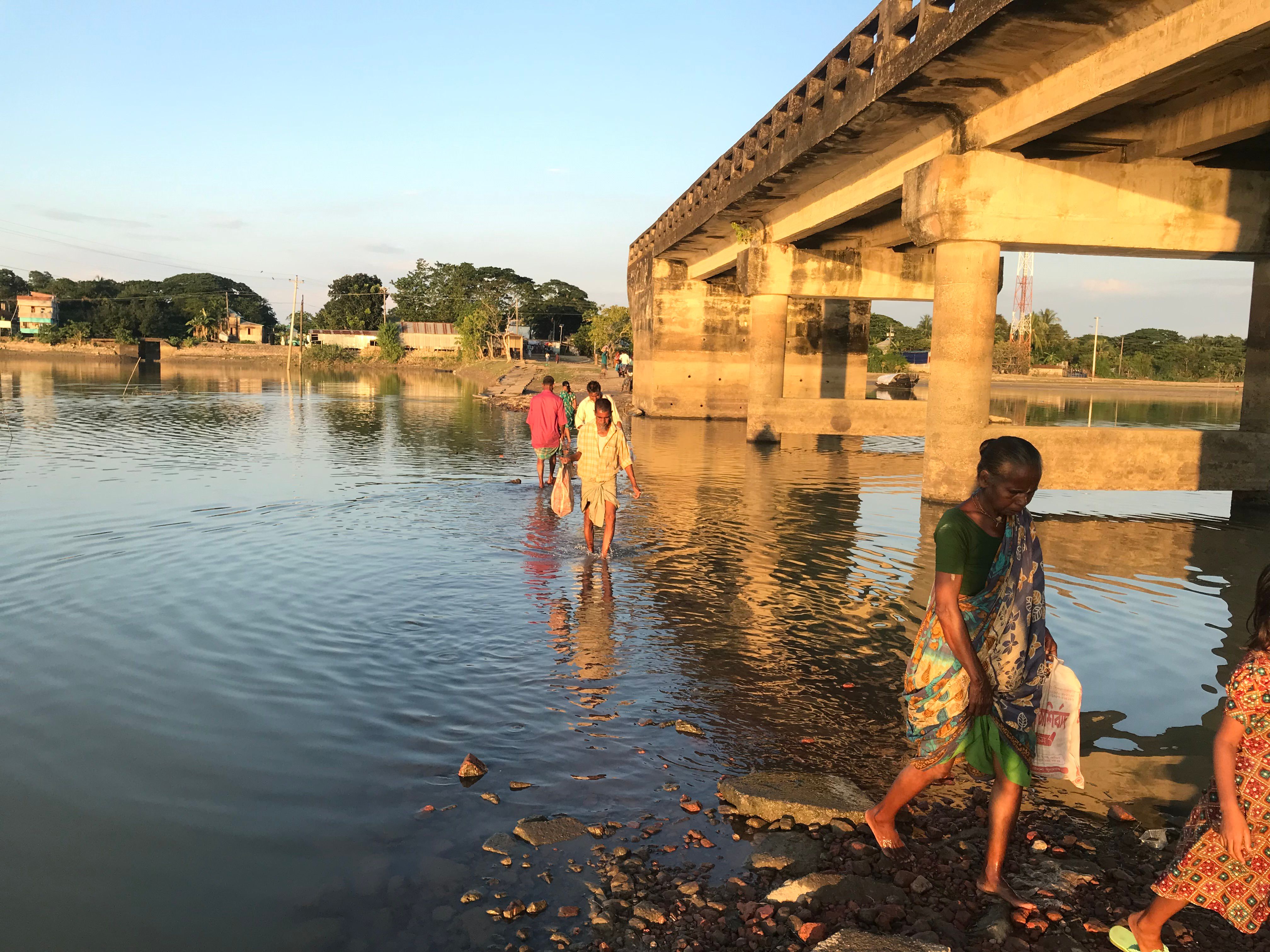
Adapting at the Water’s Edge: Local Wisdom from Bangladesh’s Haor Region
“Every year our house is submerged under water, and we somehow keep ourselves safe during that emergency. This adaptation is mandatory for us, and we hope we have taken the right adaptation measures.”
This was the statement of Amena, a 46-year-old woman from Uttar Shukhayer Rajapur in Dharmapasha Upazilla. Similar to this, thousands of people in Dharmapasha face tremendous suffering due to climatic hazards like floods, droughts, afal (erosion), heatwaves, and lightning. At present, participatory and community-based adaptation alone are insufficient to effectively manage and respond to these hazards. In contrast, locally led adaptation (LLA) is a relatively new concept that refers to a process in which local people not only participate in adaptation measures but also play a direct role in decision-making and finance. It empowers local communities and facilitates a community-driven adaptation process.
Dharmapasha is situated in the Sunamganj District, a haor region of the country. Haors are gigantic bowl-shaped floodplain depressions that serve as water storage areas during the monsoon season, receiving water from canals and rivers; however, they dry up during the summer. This northeastern subdistrict, covers approximately 1.99 million hectares, houses over 19.37 million people, and has distinctive hydro-ecological features (BHWDB, 2012). Local people employ various adaptive measures to address their suffering. A village farmer stated that “There is no work in some months, a great shortage of work, for which the number of unemployed people is also high. Because there is no suitable land during the monsoon, people often leave the area. Furthermore, we could not cultivate other crops due to the soil type, geographic location, and climatic conditions. Some of us went to the city, some did other jobs like motorbike riding, shopkeeping, and day labouring”.
Because agricultural activity is not possible during the monsoon, most people rely on alternative livelihoods during this period. Either they go fishing, open a small business, or move to city areas. Seasonal migration for work, safety, and other reasons is common in that community. There are also some floating services coming from NGOs, such as floating mobile schools and clinics.
Local people also use their traditional and indigenous knowledge in their adaptive solutions. For example, if they cannot bear the expense of sandbags to build embankments around their houses, they plant a certain type of grass that absorbs water in high volumes. They also use pillars and trees to measure water level. During the dry season, farmers plant climate-resilient seeds such as BRRI Dhan 51. Motorcycles are one of the crucial vehicles for transporting from one union to another in the dry season, so many people take that up as their livelihoods. They have their own local association, which oversees all transportation processes.
Some enthusiastic villagers are very keen to contribute to disaster management and adaptation processes. Among them, Abdur Rahman is a small-business owner and the president of the “Shekhergao Gram Unnoyan Committee”. He stated that “once an NGO named Shouhardo came to us and created a team via our own decision and choices. They told us to create a team with a president, vice president, and other members by our own votes, and we formed a team. We got training in disaster management. Now we arrange weekly/monthly meetings with the general people of the village and talk about disaster preparedness, mitigation measures, and effective response during disasters.”
But regretfully, they are not included in the finance or decision-making processes. Their perspectives and ideas are sometimes incorporated into group discussions, but this is insufficient for proper LLA. In this current approach, they are not empowered; rather, they are just informed. If proper LLA is established in Dharmapasha, the local community can build their capacity to not only respond to floods, droughts, and other hazards, but they can also build their economic resilience. The government officials, NGO workers, and most importantly, the local people of Dharmapasha may have some understanding of climate change adaptation, but they remain unaware of LLA and its potential.
The most difficult challenge for Dharmapasha is their road networks. Their communication system with other districts is very limited and they remain neglected by the local government’s road building initiatives. Moreover, their practice of mono-agriculture makes them dependent on the yields of a single crop (rice), further amplifying their vulnerabilities.
To establish LLA in Dharmapasha, these issues should be addressed immediately. There should be proper investment and transparency in climate finance. The authority must be accountable to the general people for LLA initiatives to function reliably. The NGOs must conduct flexible programs for the farmers, fisherman and other villagers who remain professionally engaged during the day. Their knowledge gaps in climate risk, climate finance, disaster risk reduction, and sustainable mitigation and adaptation measures, must be addressed through comprehensive training programs so that, just like Abdur Rahman, more community members can assume leadership positions. Their understanding will enhance their local wisdom, which they can apply to subsequent management.
Md Abdullah Al Sabid was a Research Grantee at the International Centre for Climate Change and Development (ICCCAD) at IUB. He can be reached at mdabdullahsabid5@gmail.com.