COLOCAL Partners with Nirmol Bangladesh to Conduct Community Needs Assessment to Strengthen Adaptation Capacity in Cox Bazar’s Cyclone-Prone Areas
Slide 1 of 4
COLOCAL Partners with Nirmol Bangladesh to Conduct Community Needs Assessment to Strengthen Adaptation Capacity in Cox Bazar’s Cyclone-Prone Areas
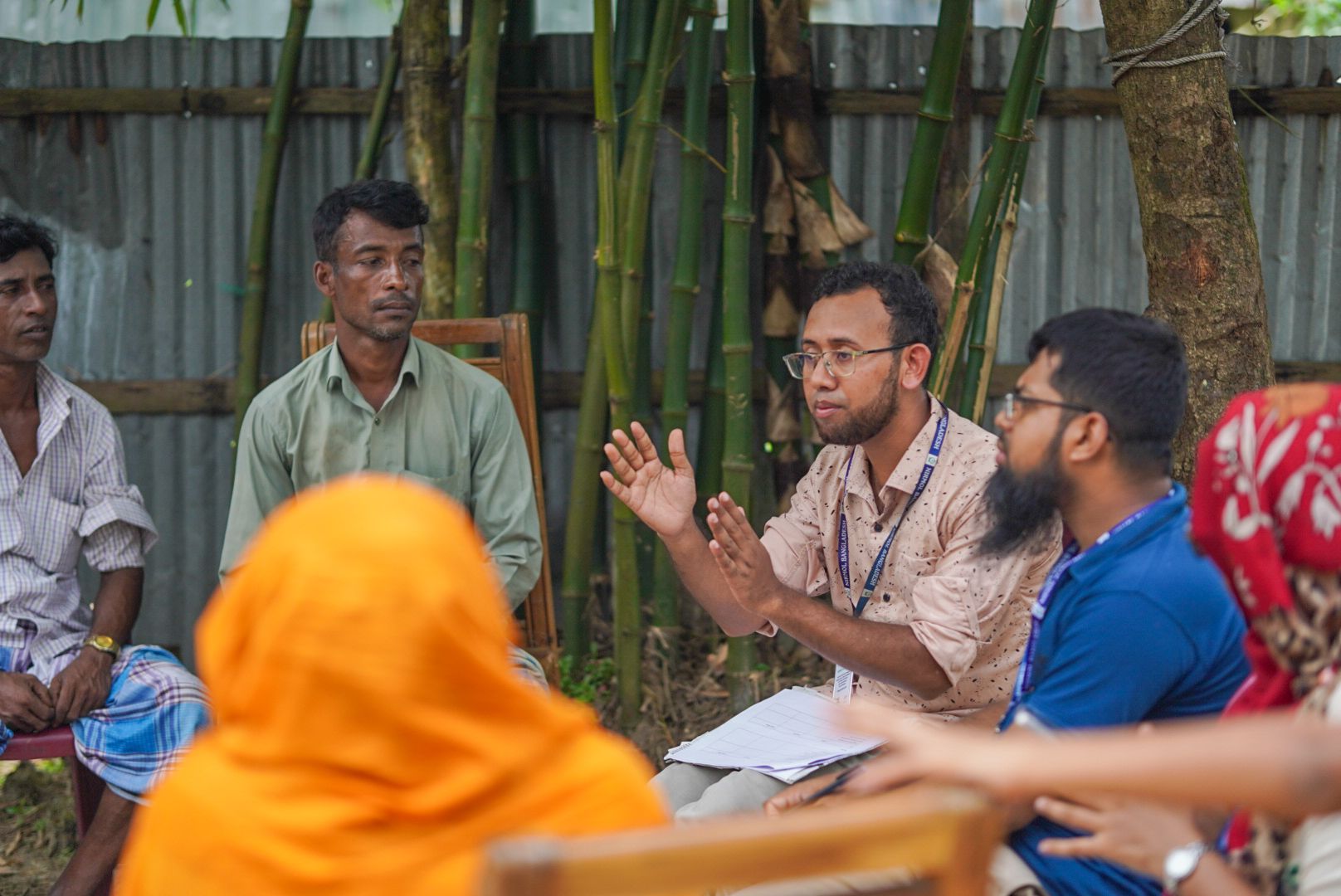
On May 21 and 22, the COLOCAL project, under DESM, IUB, conducted a needs assessment in the cyclone risk areas: Najiratake, Khuruskhul, and Choufolondi of Cox’s Bazar district. The project partnered with Nirmol Bangladesh, whose community ties and local insight were instrumental in facilitating meaningful engagement with the farmer and fisherman communities there. With this assessment and the planned training workshop following it, COLOCAL aims to co-create knowledge outputs with a view to strengthen the adaptation capacity of communities most exposed to environmental risks.
During the assessment, the team—working closely with Nirmol Bangladesh—engaged community members through group discussions and interviews to gauge their awareness of climate change and its local impacts. Some interesting findings included the locals’ belief of the Matarbari Coal Powerplant, as well as the Cox’s Bazar Wind Powerplant disrupting the ecological balance. They also expressed discontent for being excluded in the decision-making process for fishing bans. Furthermore, they heavily emphasized on the negative impacts of trawling in the region, resulting in ecological damage, overfishing, and threatening their livelihoods. As for livelihood diversification programs in the area, the fisherman communities showed a general lack of interest in activities that detach themselves completely from the lifestyle they are generationally accustomed to.
The COLOCAL project intends to leverage these findings to directly inform the development of training modules. In the coming months, the team intends to return to these areas to conduct a co-creation workshop focused on building the knowledge capacity and also creating a communication platform for the communities and the local government. This participatory approach, strengthened by local partnerships, ensures that the training will be both relevant and practical, supporting local resilience through stronger, community-driven climate adaptation strategies.
Media Coveragehttps://iub.ac.bd/news-and-events/news-archive/2025-July/6885fa558ea81bddb05a9f09