Slide 1 of 5
ICCCAD-IUB and Nirmol Bangladesh Conduct Follow-up Workshop in Cox's Bazar
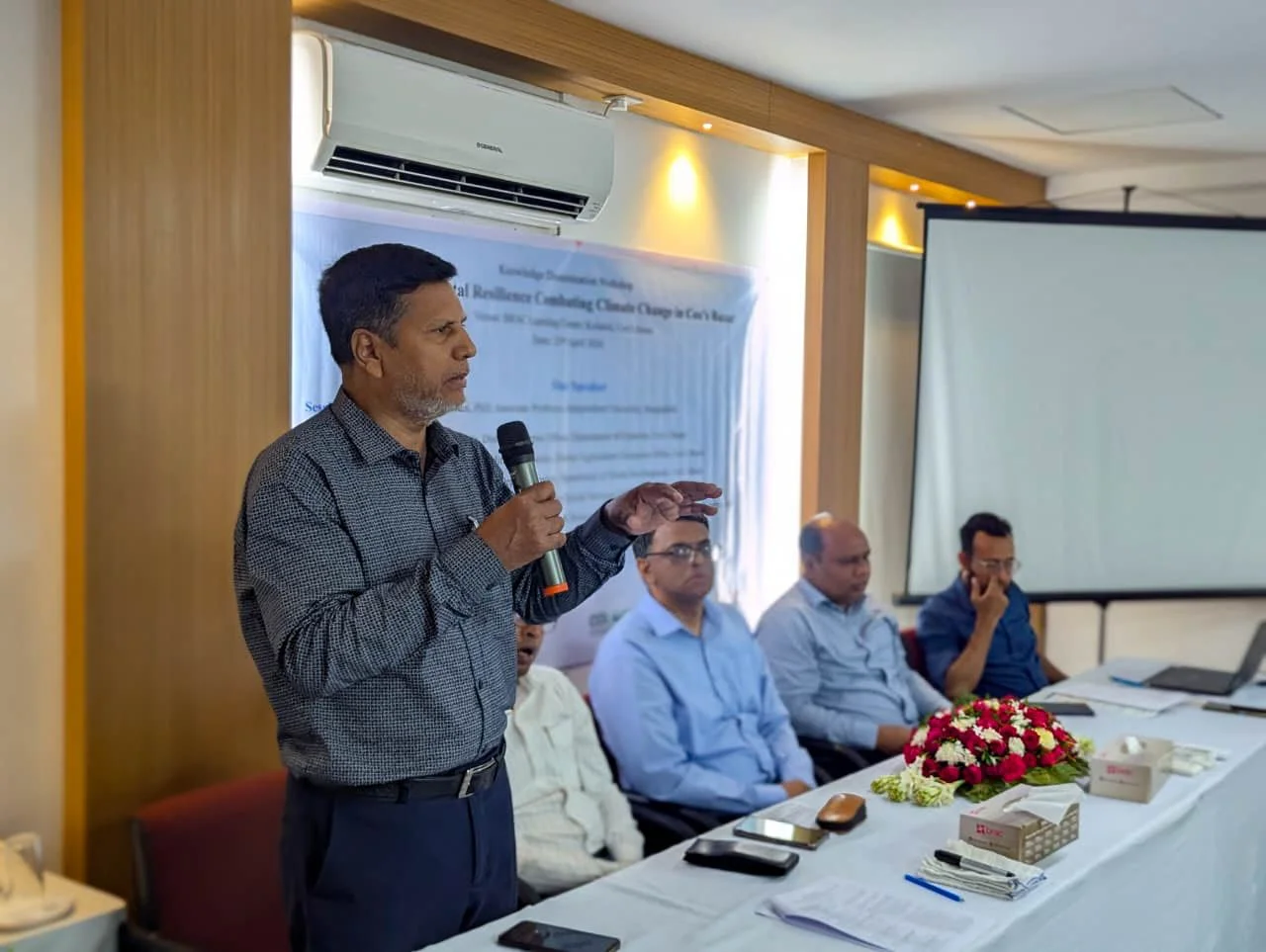
The COLOCAL project at ICCCAD-IUB, in collaboration with Nirmol Bangladesh, organised a Knowledge Dissemination Workshop titled “Enhancing Coastal Resilience Combating Climate Change in Cox’s Bazar” on 23 April 2026 at the BRAC Learning Center, Cox’s Bazar. The workshop brought together farmers, fishers, women, youth, researchers, government officials, and local stakeholders to address the knowledge gaps identified from the community needs assessment conducted previously in July 2025. The event also acted as a dialogue platform between local communities and relevant institutions.
The event started with representatives from Nirmol Bangladesh and IUB welcoming the participants. Then, Fahmid Mohtasin, Research Officer of the COLOCAL Project, outlined the purpose of the event and introduced COLOCAL, explaining how the project focuses on co-creating knowledge with grassroots communities through its research, and also aims to move away from extractive practices in research. Nirmol Bangaldesh later presented the findings from the community needs assessment, which focused on existing knowledge gaps related to climate change adaptation of local farmers, fishermen, women, and youth. The findings showed that changing weather patterns and rising salinity are steadily disrupting farming and fishing livelihoods, reducing household income, and increasing health and economic pressures on local communities. They also showed that communities are already attempting to adapt, but require technical support, training, access to services, and stronger institutional response.
Local government representatives were then given the platform to address some of these knowledge gaps, starting with Topon Kumar Roy, Additional Director of the Department of Agricultural Extension, Cox’s Bazar. He discussed how farmers in Cox’s Bazar can adapt to salinity, pest attacks, irregular rainfall, and crop damage through climate-resilient rice varieties, improved fertilizer practices, organic inputs, and more nutrition-sensitive farming approaches. He also responded to farmers’ concerns about rats damaging rice fields, whitefly attacks, and acknowledged the need for further work on temperature-tolerant seeds. Then Md. Moazzem Hossain, Deputy Director of the Department of Youth Development, Cox’s Bazar, emphasised the need for youth engagement in climate adaptation and urged the youth leaders present to have a more active presence in the scene. Md. Nazmul Huda, District Fisheries Officer, discussed how unsustainable fishing practices, including juvenile fish collection, shrimp larvae harvesting, bottom trawling, and fishing during ban periods, are intensifying the decline in fish catch and urged for stronger cooperation between fisher communities and government authorities for sustainable fishing practices.
The workshop then moved into group discussions and an open Q&A session, where local participants highlighted how weak law enforcement against pollution and harmful practices continues to undermine household-level protection and long-term resilience in climate-vulnerable areas. Dr. Ajahar Uddin, Assistant Commissioner and Executive Magistrate, later discussed how disaster preparedness can be strengthened through better institutional coordination, NGO-supported livelihood diversification programmes, youth participation, and improved community access to services.
K Ayaz Rabbani, PhD, Associate Professor at Independent University, Bangladesh, concluded the event, again promoting local knowledge and lived realities of communities over externally prescribed solutions. He described the workshop as part of a broader capacity-building journey and encouraged participants to continue sharing locally generated knowledge through wider platforms.