Slide 1 of 8
Makerere University’s Initiatives to Empower Local Farmers to Lead Collaborative Learning for Climate Change Adaptation in Uganda
Climate change continues to disrupt agricultural production, placing local farmers who depend heavily on nature for survival at a growing risk. As part of the COLOCAL project activities in Uganda, Makerere University, in partnership with the Kiboga District Local Government and local farmers, implemented farmer-led collaborative learning processes. The intention of these activities was to support the development of solutions that are grounded in local realities and the farmers’ expressed needs, and that build capacity and ownership within the farming community.
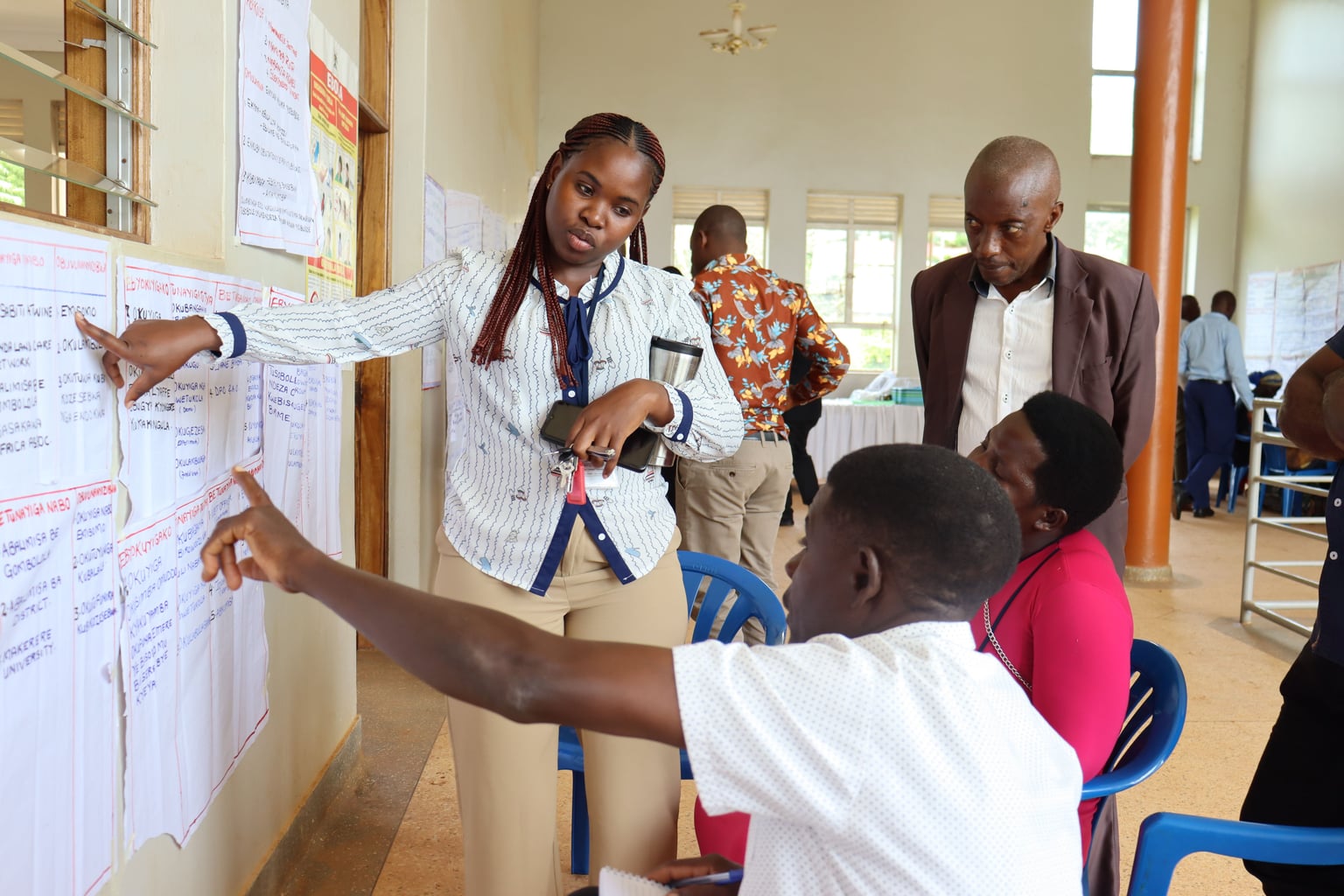
The initial process, once the farmer groups had been created, involved the farmers identifying and prioritizing learning needs and creating a collaborative learning plan. The plan included learning objectives, working procedures, intended activities and roles for partners that the groups identified. This stage concluded with the sharing of the collaborative learning plans and needs with potential partners that the farmers had identified, which included model farmers in the community, technical officers from local government, political leaders, representatives of Non-Governmental Organization (NGO’s), private sector actors and researchers.
A workshop was then organized where farmers worked together with the partners they had identified to develop specific cooperative actions that would help the farmers address their learning needs. The various commitments made and resources provided to farmers at this workshop allowed them to address their learning needs using different methods. The methods used included demonstration gardens, facilitated discussions, farm visits, and learning-by-doing experiments. Model farmers showcased her best practices for feeding goats, coffee farmers demonstrated how the establishment of trenches (Fanya-juu) can help control water run-off during the rainy season, etc. The collaborative learning process also included dissemination events where farmers presented their findings to, amongst others, fellow farmers, community members, religious leaders, and political representatives. The events provided an opportunity to link farmer-led learning to policy and practice on climate change adaptation.
The farmer-led collaborative learning process empowered local farmers in the following ways:
● Confidence in informing and owning decision making
Farmers, including the youth, women, and elderly, confidently presented and shared their adaptation priorities with political and technical leaders during collaborative learning meetings and workshops. This provided an opportunity for farmers to articulate their own priorities rather than having adaptation decisions imposed by external actors, thereby ensuring that adaptation measures captured their needs and were responsive to local realities.
● Network building for information and resource access
Network linkages established through collaborative learning strengthened farmers’ connections with model farmers, agriculture extension workers, NGOs, and community-based organizations. These relationships expanded their access to knowledge, resources, and built their social capital. Through collaborative learning, the farmers were better positioned to make informed choices on best farming practices that resulted in increased agricultural productivity.
● Collective action to challenge the status quo
Collaborative learning provided an opportunity for farmers to work together and jointly identify their priorities. Organizing these priorities as a unified demand, rather than as scattered individual concerns, strengthened their collective voice. By presenting a unified set of priorities, farmers were better positioned to influence government decision-making through the inclusion of their needs and priorities in district planning and budgeting cycles. This challenged the status quo, which was largely characterized by government pre-determining interventions and farmers being treated as passive recipients.
● Recognising and strengthening inherent capacity and capabilities
Farmers showcased their capabilities by demonstrating how learning needs were addressed using locally available resources. By sharing indigenous and experiential knowledge, farmers highlighted practical solutions rooted in the local context. This process fostered strong local ownership of adaptation measures, as farmers viewed the solutions as their own rather than externally imposed. Such ownership laid the foundation for sustainability by increasing long-term commitment, continuity, and the likelihood that adaptation practices are maintained and adapted over time.